
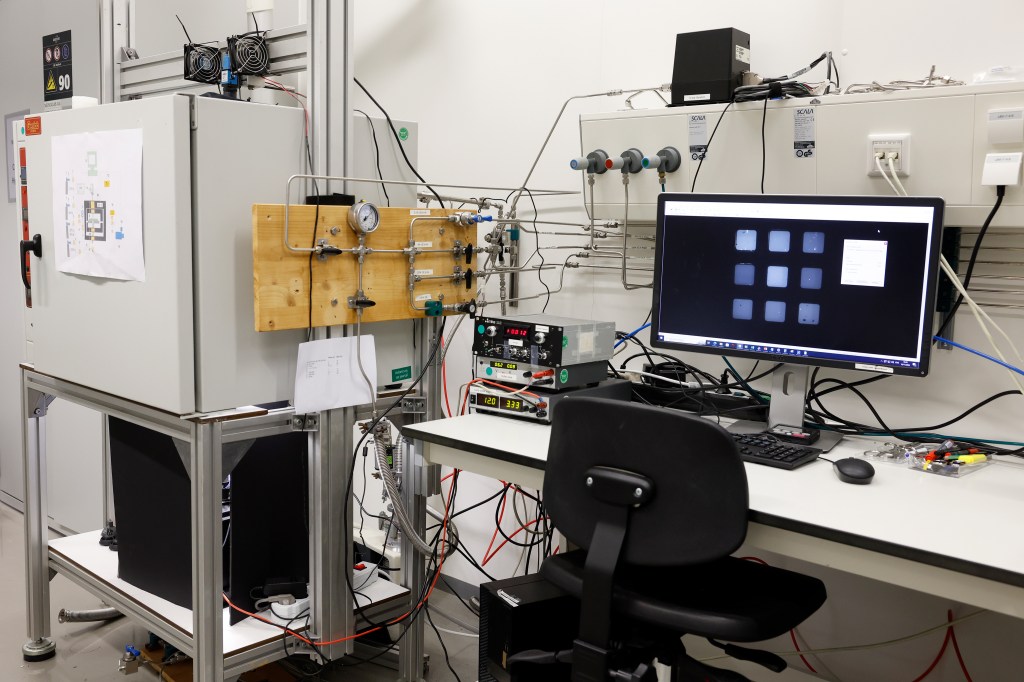
In hydrogenography, we monitor the optical transmission of one or more thin films over time while exposing it to different partial pressures/concentrations of hydrogen at a set temperature (up to 270 °C). To do this, a set-up has been developed where a pressure cell containing the samples is positioned inside an oven. Optical windows on the bottom and top of the oven and the pressure cell allows light coming from the LED light source positioned below the oven to be transmitted through the samples to the camera located on top of the oven. To vary the hydrogen partial pressure inside the pressure chamber, we change the absolute pressure of a hydrogen containing gas mixture (multiple available) between 0 and 10 bar.
The hydrogenography is the first step in studying the (optical) properties of hydrogen sensing materials. Typically, we perform optical transmission measurements of samples by stepwise exposing them to a series of increasing and decreasing hydrogen concentration/pressure steps. Next, this information is often summarized by taking the average transmission value across time at a certain hydrogen concentration to obtain a plot of the changes in optical transmission as a function of the hydrogen concentration/partial hydrogen pressure. This allows us to obtain information about the hydrogen concentration/pressure range in which the material absorbs hydrogen, the magnitude of the optical response of the material to a change in hydrogen pressure and the presence or absence of hysteresis. Furthermore, we can perform measurements of the response time of the samples or expose samples repeatedly to the same pressure step to obtain information about its stability.
The application of hydrogenography goes beyond hydrogen sensing materials. It has been used extensively in the past to study hydrogen storage materials. For example, we can measure the partial hydrogen pressure dependence of the optical transmission at multiple temperatures to determine the entropy and enthalpy of hydrogenation with the help of Van ‘t Hoff’s law. In addition, through clever sample and measurement design, we can also determine (absolute) diffusion rates of thin film materials with this set-up.
 TU Delft Optical Hydrogen Sensing & Thin Film Energy Materials